
Articles | Dr. Masoumeh Jorjani
Expression patterns of ERα66 and its novel variant isoform ERα36 in lactotroph pituitary adenomas and associations with clinicop

writer :
-

author :
-
.png)
Translator :
-

year of publication :

Publishers :
-
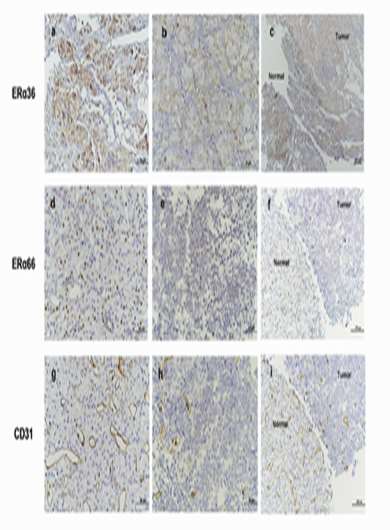
Abstract Purpose The regulatory effects of estradiol on pituitary homeostasis have been well documented. However, the expression patterns of ERα66 and ERα36 and their correlations with the clinical course of postoperative prolactinoma tumors remain unclear. Methods The expression of ERα36, ERα66, Ki67, p53, and CD31 were determined by immunohistochemistry in 62 prolactinoma patients. Snap-frozen tumors and normal pituitaries were also examined by western blotting for estrogen receptor detection. Results A broad expression of ERα36 was identified in normal pituitaries. The median scores of ERα36 and ERα66 expression were 8 and 6 in normal pituitaries and 4 and 0 in tumors, respectively. Four phenotypes of ERα36 and ERα66 expression were explored in tumors with regard to sex, invasiveness, dopamine resistance, and recurrence. Low ERα36 expression was associated with tumor invasion and increased Ki67. Low ERα66 expression was associated with tumor invasion, dopamineagonist resistance, and enhanced tumor size. Multivariable logistic regression analysis showed that low ERα36 expression is an independent risk factor for invasiveness. The significant inverse association of ERα66 with invasiveness, dopamine resistance, and tumor size remained significant after adjustment for sex as a potential confounder. After controlling for sex, the low ERα66/low ERα36 phenotype was 6.24 times more prevalent in invasive tumors than in noninvasive tumors. Although the decreasing trend of CD31 expression from surrounding nontumoral lactotroph adenomas to tumors was similar to that of the estrogen receptors, a significant correlation was not observed here. Conclusion The decreasing trends of ERα36 and ERα66 expression from normal pituitaries to tumors are associated with aggressive clinical behavior.